A bigger circle
Public trading of art has a relatively short history in China. The first auction house, China Guardian Auctions Co. Ltd, was established in 1993 with government assistance.
"Before that, collectors and art lovers only traded privately. Art collection was an issue within a small circle," Kou Qin, director and vice president of China Guardian, said at a summit hosted by Zhilan Yaji, an art collectors and dealers club, on Dec 8 in Beijing. Soon the small circle expanded.
|
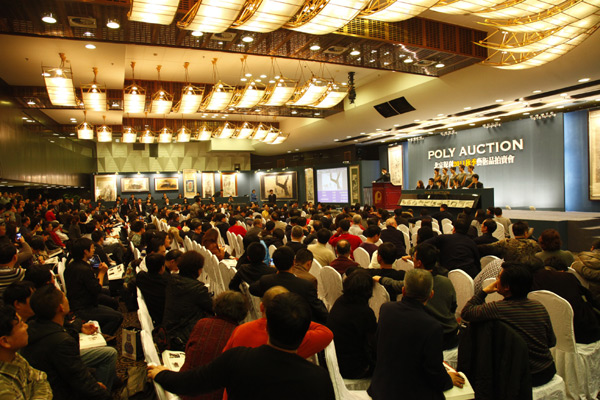 The last night of the fall Poly Auction on Dec 9 in Beijing, which ended with a total hammer price of 4.95 billion yuan. Gao Erqiang / China Daily |
In 2005, China's leadership encouraged people to "increase their property income instead of their labor revenue," and people took the opportunity to manage and increase their money through investments, said Liu Shuangzhou, a professor in the law school at Central University of Finance and Economics.
With the economy booming, art joined stocks and real estate as a financial tool. Its market closely followed the capital markets starting in 2006.
In 2009, the prices paid for several art items opened what art auction people call the Era of a Hundred Million Yuan. Stockbroker Liu Yiqian bought a piece of Song Dynasty (960-1279) calligraphy for more than 170 million yuan, which approached the world record for Chinese painting and calligraphy at the time.
Last year, China became the No 1 arts market with one-third of the world market share, according to Artprice.com, a market monitor and analyst since 2000. The United States had held that rank.
Seeing, setting value
|
 |
Chinese calligraphy or a painting worth more than 100 million yuan today might not have fetched 10 million just 10 years ago, said Hu Yanyan, director of the painting and calligraphy department at China Guardian Auction, but now the public recognizes its value.
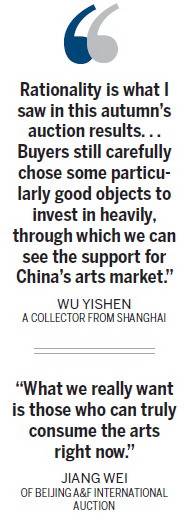
"Though this year the whole market is not as good as expected, we are still impressed by the consumption capacity of our new customers," said Jiang Wei.
"They paid quickly for the collection items and inquire little about the investment value in the future."
Jiang works at Beijing A&F International Auction. He said these customers have huge buying power and the next step the auctioneers should take is to find ways to cultivate them in a new area, art as an investment. Maybe only 1 percent will come to truly appreciate the art, he said, but "what we really want is those who can truly consume the arts right now."
Individuals are not the only investors capable of boosting the market. Nearly 30 arts funds companies on China's mainland entered the market controlling a total of 5.8 billion yuan, according to a recent report on a one-year survey by Money Journal magazine and Xinhua Holdings. These funds buy art strictly as an investment, using pooled money, and usually do so anonymously.


Copyright 1995 - . All rights reserved. The content (including but not limited to text, photo, multimedia information, etc) published in this site belongs to China Daily Information Co (CDIC). Without written authorization from CDIC, such content shall not be republished or used in any form. Note: Browsers with 1024*768 or higher resolution are suggested for this site.
License for publishing multimedia online 0108263 Registration Number: 130349