Vanishing Chinese folk handicrafts
Updated:2011-12-01 16:54
By Sun Chi (chinadaily.com.cn)
|
 |
|
Editor's Note: The destinies of many folk crafts are similar, suffering many twists and turns. Over the past millennium, some have died and some others are in the process of dying off, and may be lost from human history. |
|

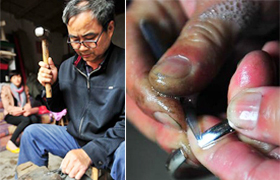
China has been using silver for over 4,000 years since the Warring States Period (770-256 BC), reaching the peak of its prosperity in the Han and Tang dynasties (206 BC-AD 907). Chinese people have entrusted their aspirations, such as longevity and wealth, upon silverware and gold, gradually forming an ornamental folk culture. Nowadays, silversmiths in China are no longer in demand, though silver as an ornament is still popular. Hong Jinquan - a gray-haired old man - works at a hundred-year-old gold and silver processing shop along Beizha old street in Chaohu city, Anhui province. Many of the works showcased in this old shop, such as silver locks... |

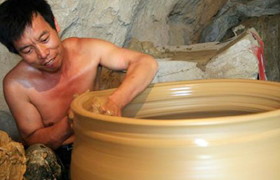
A hand-made water vat is a local craft with over two hundred years of history in Hongtong county, Shanxi province. The water vat is made from powdered stone found in the mountains nearby. With modern developments, many hand-made water vats are being replaced by modern containers and their folk craft is thereby vanishing. Zhang Qiusheng's hand-made water vat mill is the one survivor out of 150 similar ones, but it runs for only half a year. "The hand-made water vat market has all but disappeared," said Zhang. "Only a few distilleries need a limited amount of my water vats for storing fermented wine and I have to offer a doorstep delivery service." |
|

Wang has been carrying on his ancestral techniques of rice wine-making for 30 years since the reform and opening-up of the country. He keeps from drinking his produce, but can make superb rice wine by estimating the concentration of the distilled liquor... |
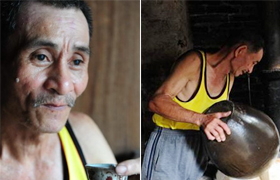 Wang Lijiao, a 61-year old wine maker, lives in a three hundred-year-old mansion at the center of Xiansai village near Qionghai city, Hainan province. Stepping into this old mansion, one can smell the mellow scent of Wang's home-made rice wine.

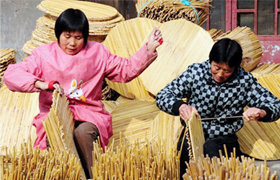
There is a long history of making sorghum stalk boards in Nianshang village, Linyi city in East China’s Shandong province. Chen Zhenchang, a 69-year-old villager from Nianshang, said his grandparents were making the covers in different sizes for as long as he can remember. The round boards are made of Chinese sorghum stalk, through a multiple-step process. And they are used as covers for pots and pans, or trays. Since reform and opening-up, more than 400 families in the village have been living off this trade. In addition, a kitchenware company was established to produce and sell the covers. The village was also designated "the village for sorghum stalk board processing" by the local county government.
|
|

Yin was born into a family of steelyard hand-craftsmen in Weishan county. He began to learn this technique from his grandfather at the age of 11 and started up his own business in Lincheng township when he was 19. |
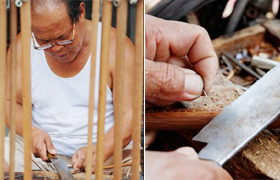 Vanishing traditional techniques leave us a rich historic and cultural heritage. Yin Zhaozhen is a 58-years-old steelyard craftsmnan, who lives in an old street of Zaozhuang city, Shandong province.