 |
|
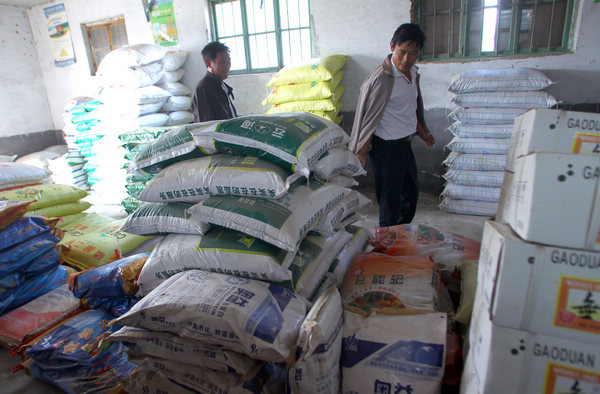
Fertilizers and other farm chemicals are available in this small store in Shouguang, Shandong. [Photos by Zou Hong / China Daily] |
"I don't think farm chemicals are as horrible as some people believe," said Pan Canping, director of the Agriculture Ministry's Quality Testing and Inspection Center for Agricultural Products.
Severe insect and plant disease infestations afflict roughly 60 percent of cultivated land in China, Pan said. He estimated that farm chemicals save 58 million tons of grains, 1.5 tons of cotton, 50 million tons of vegetables and 6 million tons of fruit every year.
Pan said Chinese agriculture is moving toward a healthier, environmentally friendly development.
Use of highly toxic and hypertoxic agricultural chemicals is forbidden for insect control, and they cannot be applied to vegetables, melons, fruits, tea, and herbs used in traditional Chinese medicine. The regulations were issued by the Ministry of Agriculture in 1997.
Farm chemicals must be registered before they can be sold. By the end of last year, the ministry had approved registration for 600 farm chemicals marketed under 14,000 brands.
After evaluation by the ministry, changes in the "maximum use" labeling - sometimes allowing stronger solutions, sometimes weaker - were required for 200 chemicals. The ministry plans to regulate 7,000 other kinds of farm chemicals, completing those most commonly used, within five years.
Important interval
For modern agriculture, chemicals including fertilizers seem to be unavoidable not only in China but also in other countries. But their potential for harm can be mitigated by generally agreed-upon good agricultural practices (GAP). Practices vary by jurisdiction, but China's GAP took effect in May 2006.
The principles are broadly outlined for the farm level in 10 areas, including crop and fodder production, harvest and on-farm processing and storage. The common theme is that all possible measures must be taken to prevent food-borne disease as fresh produce moves through production and distribution systems.
For example: To extend their effectiveness, some pesticides contain chemicals that keep them from easily being washed away by rain. It takes time for those chemicals to break down into harmless compounds, so it's important to use minimal amounts and to allow sufficient time to elapse between the last application and harvest.
"We called it the pre-harvest interval, which is an important part of GAP," said Pan, the quality testing and inspection director. "Only by following GAP strictly can we enjoy safe agriculture products."
Pan said more than 96 percent of vegetables in China meet safety standards for chemical residue. Those that do not result from failure to follow GAP principles. "The problem not only exists in China, but also in advanced countries," he said.


Copyright 1995 - . All rights reserved. The content (including but not limited to text, photo, multimedia information, etc) published in this site belongs to China Daily Information Co (CDIC). Without written authorization from CDIC, such content shall not be republished or used in any form. Note: Browsers with 1024*768 or higher resolution are suggested for this site.
License for publishing multimedia online 0108263 Registration Number: 130349