Loggers encouraged to develop new businesses as trees protected, report Dachong and Peng Yining in Tibet.
 |
|
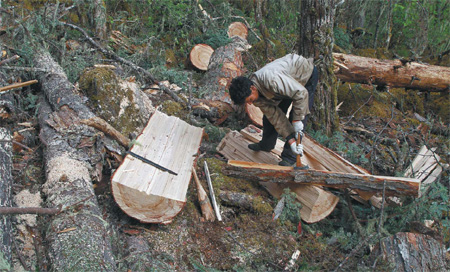
Dawa, who earned his first ax 23 years ago, will use this spruce to repair the house he built. Tibetans in Nyingchi prefecture are allowed to fell five trees annually for that purpose, but commercial logging is banned. Photos by Feng Yongbin / China Daily |
For centuries, when boys turned 17 in Nyingchi prefecture, the Tibet autonomous region, they were asked to cut down a giant spruce tree to prove their manhood.
Dawa, a 40-year-old Nyingchi resident, said the murky virgin forests were the most profitable resource in mountainous Nyingchi, so a man's logging skills determined whether he could make a living and feed a family.
Dawa got his first axe at 17 after spending three hours felling a spruce "which was so thick that two adults could barely encircle it with their arms".
Dawa continued in the footsteps of his father and grandfather. "The only money I have ever made was in logging", but his 11-year-old son might not have the same opportunity, he said.
Large-scale commercial logging in Nyingchi prefecture, which holds the richest store of timber in Tibet, was banned last year. But the industry has been in decline since 2000 when the government initiated conservation measures.
Tibetan loggers had to wave goodbye to a centuries-old lifestyle based on lumbering and look forward.
All his work
Every piece of wood of Dawa's house was cut by Dawa himself from the surrounding leafy hillsides. It took him nearly two years and more than 30 big Picea (spruce) trees to build his family of four a two-story shelter near a river at the foot of an immense verdant hill.
Bark and branches, the family's main fuel, are piled in the yard. Inside, the furniture was all made from timbers, and Dawa carved out the wooden bowls and spoons from scraps. He said more than 600 shingles, made from five 100-year-old trees, were needed for the roof alone.
Dawa's family keeps 30 yaks and dozens of sheep but only for butter and meat. Most of their income used to come from lumbering and selling logs.
Slow, but strong
Solemn emptiness and the desolate southern edge of the Gobi Desert dominate the landscape of the Tibetan plateau. But for thousands of years, warm moist air flowing south has been stopped by the Himalayas and has nurtured boundless virgin forests in southern Tibet's mountains.
According to official reports, 51 percent of Nyingchi prefecture is covered by forest. The trees blanket 1.2 billion cubic meters and total 10 percent of the nation's supply, ranking fourth behind Heilongjiang, Sichuan and Yunnan provinces.
Dawa said trees grow very slowly here at 3,000 meters elevation, but very straight and thick. The price of Tibetan spruce increased from 80 yuan ($12) per cubic meter in the 1990s to 200 yuan in the 2000s. He could make more than 20,000 yuan a year from lumbering, plus 3,000 yuan by farming.
While the government has banned commercial logging, local Tibetans are still allowed to cut five spruces a year to repair their houses.
An apology
"Good-quality timber has straight lines on its bark," Dawa said as he climbed through a thick forest, looking for a straight spruce to renew parts of his roof. He quickly spotted a tree more than 80 centimeters in diameter. "I was taught how to cut wood even before I was able to lift an ax."
Before the ban, Dawa and other men in the village cut wood from autumn through spring. Summer was the season for herding.
Trees were shaved into logs by removing the limbs, and cut into optimal length, usually 1.5 meters. Boards were cut from the timbers and carried downhill on loggers' backs after four or five months of air-drying.
With axes, a group of four loggers could cut down three spruces a day. When diesel-fueled saws came in during the '90s, a single logger could easily lay down 10 trees a day.
With a great noise from his power saw and a spray of wood chips, Dawa cut down the spruce. Translucent sap oozed from the stump, and the smell of fresh-cut wood pervaded the air.
Dawa touched the tree's growth rings - the dense circles indicated the tree probably had lived more than 100 years - and said he was sorry for cutting down this beautiful plant.
"Our religion requires us to respect all kinds of lives, but we need wood for building shelters," he said. "For visitors, it might be exotic, even romantic to live in tents, but we want to live in a safe house without a leaking roof.
"But even without official protection, every Tibetan village has a holy area (usually a mountain or a lake) where locals can't log or hunt."


Copyright 1995 - . All rights reserved. The content (including but not limited to text, photo, multimedia information, etc) published in this site belongs to China Daily Information Co (CDIC). Without written authorization from CDIC, such content shall not be republished or used in any form. Note: Browsers with 1024*768 or higher resolution are suggested for this site.
License for publishing multimedia online 0108263 Registration Number: 130349