Comments
  Print
Print  Mail
Mail  Large Medium Small
Poor bear the brunt as illegal traffickers prey on their vulnerability, Li Li reports.
 |
|
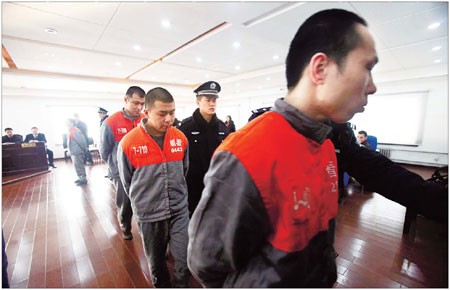
Accused organ traffickers entered Beijing Chaoyang District People's Court on Feb 15. He Linxuan, Ye Weihua, Zhen Dingliang and Si Zhenqiao admitted their involvement in a ring that brought in 118 million yuan. Provided to China Daily |
Ma Yanqing, 37, is getting used to a new heartbeat. The Guangdong migrant worker had a transplant in January, two months after he was taken to Tongji Hospital in Wuhan, capital of Hubei province.
"We are lucky," said Yin Huamei, Ma's wife. "I heard people waited for years."
According to the Ministry of Health, about 1.5 million people in China need organ transplants every year, but only around 10,000 operations are performed, due to a shortage of donated organs. The huge gap has led to the emergence of an illegal organ trade.
"The scarcity of available human organs is a global phenomenon," said Deng Liqiang, legal affairs department director at the Chinese Medical Doctor Association.
"It is just more obvious in China because of the number of illegal organ trades due to poverty."
To crack down on human organ trafficking, the National People's Congress Standing Committee, the country's highest legislative body, passed an amendment on Friday to the current criminal law that adds organ trafficking as a specific crime. Previously, traffickers were usually charged with operating an illegal business. The amendment also says that criminals convicted of "forced organ removal, forced organ donation or organ removal from juveniles" could face punishment for homicide, including the death penalty. The amendment will take effect on May 1.
The gap
"I have seen people wait for three to five years for the right organ," said Professor Chen Shi, deputy director of the Organ Transplant Research Institute at Tongji Hospital.
In 2007, the State Council issued the Regulation on Human Organ Transplantation and banned organ trafficking as well as organ donations to people who were not relatives. The black market continued, fueled by the need for money by the poor and the demand for organs by the rich.
Many people risk their lives to sell their organs. Some work as intermediaries, matching donors and people in need of transplants and providing forged identity documents.
In Beijing Chaoyang District People's Court on Feb 15, four people admitted their involvement in an organ trafficking ring that brought in 118 million yuan ($17.9 million). According to news reports of the trial, ringleader He Linxuan, 26, from Zhejiang province, recruited "donors" and traded organs for nine transplant operations in 2008 and 2009.
Ye Weihua, Zhen Dingliang and Si Zhenqiao, all from poor families, told the court they had "learned from the Internet" that they could make money by selling their own kidneys, and they contacted He. Each received 40,000 to 50,000 yuan after selling one kidney. Lured by large profits, they joined He in this illegal trade.
The men were charged with illegal business operation and pleaded guilty. The court hasn't announced their sentences.
Four similar cases were also tried in Beijing recently. Among all five, most of the organ traffickers were from remote or underdeveloped areas, and most had sold one of their kidneys.
"Trading human organs makes organ transplant only serve the rich," said Deng, the Doctor Association's lawyer. "The phenomenon intensifies the inequality of the society."
How do they work?
Advertisements by so-called organ agents can be found in places ranging from toilet walls in hospitals to the Internet. Type the key words "liver supply" and "kidney source" on Baidu, a popular search engine in China, and you'll see 100,000 hits.
Pretending to be a uremia patient in need of a kidney, a China Daily reporter dialed the phone number of a group that claims to be the biggest organ transplant agent in China and to have had long-term relationships with many organ transplant hospitals in China. The phone number was registered in Linfen, Shanxi province.
"No problem - 200,000 RMB for a kidney," said a Mr. Dong, who promised on the phone to find a suitable donor within a month. "The money includes the donor's surgery, medical care, transportation, accommodation, documentation and agent fee."
When asked how his group could get around the law, Dong snickered. "That's not your concern," he said. "We have a network of people in hospitals and related documentation departments."
Another agency advertised online - with the slogan "saving lives while helping people in need for money" - that heart, liver, kidney, cornea and even newborn babies were all in its "collecting range".
"Free accommodation and meals. We won't charge you anything until after the surgery," said a letter to possible donors posted on its website. "Just think it through and bring your identity card over."
Liver cancer patient Wang Qinglian, 65, had a liver transplant in the General Hospital of Armed Police Forces in Beijing in October. He confessed he would have considered illegal channels for a liver if he failed to get one from the hospital in time.
"To live is the most important concern for a cancer patient," he said.
Lapses in hospitals' identity verification systems allowed the acceptance of fraudulent documents: Strangers could turn into close relatives of patients.
"Once, I overheard the patient asking his alleged cousin, 'What's your name again?'" said lawyer Deng, who also is a doctor who no longer practices medicine.
Some doctors interviewed for this report said they aren't trained to be criminal detectives and are victims themselves as the money-making tools of organ traffickers. Professor Chen is skeptical. "It is more likely that some doctors irresponsibly turn blind eyes to those actions or, worse, they are bribed and take part in the crime."
 Looted cultural relics displayed back in China
 Zhengzhou starts rail cargo service to Hamburg
 Jobless graduates swarm to grad school
 Fu becomes oldest living person at 116
 Peking University a hot tourist spot
 Building stands alone in East China
 Rain leads to bigger waterfall in C China
 Bruce Lee exhibition to open in Hong Kong
Copyright 1995 - . All rights reserved. The content (including but not limited to text, photo, multimedia information, etc) published in this site belongs to China Daily Information Co (CDIC). Without written authorization from CDIC, such content shall not be republished or used in any form. Note: Browsers with 1024*768 or higher resolution are suggested for this site.
Registration Number: 20100000002731