hotrecommend
Mongolian medicine recovers
By Cao Li (China Daily)
Updated: 2010-08-25 09:11
 |
Large Medium Small |
Waiting for relief
As word of mouth about traditional medicine has spread, and as people generally become more health-conscious, practitioners in Hohhot, the regional capital, and on the China-Mongolia border in Erenhot say they have witnessed a steady increase in customers over the past five or so years.
Patients at a clinic run by Surongzhabu, who in 2009 was listed among the 30 most renowned doctors of traditional medicine in China by the Ministry of Health, have to wait in line for about 30 minutes for a ticket to see him.
|
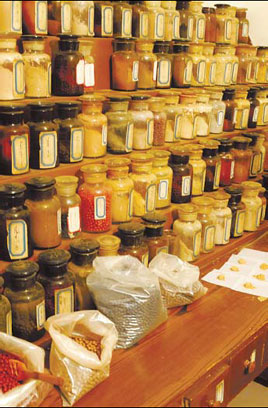 Traditional Mongolian remedies are made up of natural ingredients, some of which can no longer be found. Related video:Mongolian medicine recovers |
"When modern treatments face bottlenecks in dealing with diseases like cancer, cardiovascular disease, diabetes and high blood pressure, people come back to traditional medicine," said Burendalai, deputy dean of Inner Mongolia Medical College's school of Mongolian medicine.
However, practitioners say more must be done if the traditional ways are to be preserved and developed.
Temuqile, who has been practicing for two decades at Hohhot Zhongmeng Hospital, said the revival could be in jeopardy if the authorities do not increase support.
"The resources are not enough to meet the growing demand," said the 42-year-old, as he stood in his clinic surrounded by patients with needles in their faces and glass cups on their backs.
Beds are always in short supply at the Inner Mongolia Hospital. Although it has 500 beds allocated for traditional medicine, it often has more than 600 registered in-patients, according to its vice director, Wulijitegusi.
Help is on the way, though, with 25 hospitals specializing in traditional Chinese and ethnic Mongolian medicine now under construction across the autonomous region.
Among the projects is the International Mongolian Medicine Hospital in Hohhot, which will have room for 700 beds and be able to handle 1,000 outpatients a day. The 18-floor building is scheduled for completion this year.
In addition to new facilities, many also argue that some of remedies need to be updated for the 21st century, albeit carefully. "Doctors used to massage patients with milk cream, which could be considered too smelly now," said Surongzhabu. "Putting fresh sheep skin on a woman's stomach to cure a cold womb (menstrual cramps) is not very practical, either."
Agula, director of Inner Mongolia Medical College's school of Mongolian medicine, agreed and said the system needs to be revised to come in line with international standards and modern technologies.
"Mongolian practitioners that detect illness mostly by touching veins and observing people's faces and complexions need to get to grips with new technologies that are more accurate," he said. "Treatments also must become more sophisticated."
One thing is for sure, added Luhaiwen, director of Erenhot Hospital: "Mongolian medicine cannot survive on its own. It needs to be combined with modern medicine and traditional Chinese medicine to have the best effect."