Synchronized Swimming
It looks like perhaps the most effortless event in the Olympic Games, but
there is more to synchronised swimming than what appears on the surface. Besides
demanding strength, endurance, flexibility, grace and artistry, it requires
exceptional breath control.
|
 |
|
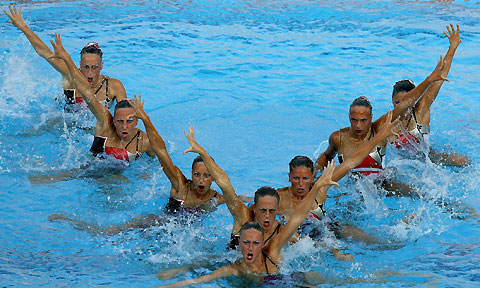
The
Italian synchronized swimming team competes in the team final during the
European Aquatic Championships in Budapest, Hungary, July 30, 2006. The
Italian team won the bronze medallion.
[Reuters] |
Unusual, but vital, equipment helps the women maintain the illusion of
effortlessness, no simple task considering they perform strenuous movements
upside down and underwater while holding their breath. A nose clip prevents
water from entering the nose, allowing the swimmers to remain underwater for
long periods. Gelatine keeps the hair in place. Make-up brings out the features.
Most importantly, an underwater speaker lets the swimmers hear the music
clearly while underwater, helping them achieve the split-second timing critical
to synchronised swimming.
Originally known as water ballet, synchronised swimming began in Canada in
the 1920s. It spread to the United States in the early '30s, where a display at
the 1934 Chicago World's Fair drew rave reviews. Its popularity soared further
when Esther Williams performed in a string of MGM "aqua musicals" in the 1940s
and '50s.
COMPETITION
Synchronised swimming emerged as an exhibition sport at the Olympic Games
from 1948 to 1968, then debuted as a full medal sport in Los Angeles in 1984. It
is open only to women, with medals offered in two events: duet and team.
Competition for both events consists of a technical routine and a free
routine, each performed to music within a time limit. In the technical routine,
swimmers perform specific moves in a set order, including boosts, rockets,
thrusts and twirls. In the free routine there are no restrictions on music or
choreography. Judges of each routine look for a high degree of difficulty and
risk, flawless execution, innovative choreography and seemingly effortless
performance.
The judging for synchronised swimming resembles the judging for figure
skating. Two panels of five judges assess a performance, one panel scoring
technical merit and the other assessing artistic impression. In both cases, each
judge awards a mark out of a possible 10.
LIST OF EVENTS
Duet Women Team Women