|
|||
 |
|||
|
|||
|
|||
|
|||
|
|
||||||||||||||||||
Bird's Nest to nest egg(China Daily)Updated: 2007-07-13 10:25 Olympic memorabilia in China are starting to resemble stocks on the domestic market: sales are booming and even exorbitant prices are not deterring "investors."
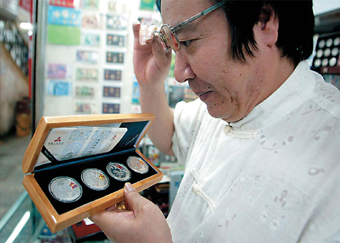
Which has had the effect intended by China's policymakers, who have embarked on a common sales strategy of releasing "limited-edition" luxury goods to drive up demand and prices. "After just over a month, the cost of Olympic coins has skyrocketed," Wang, a man in his late thirties who has been collecting coins for almost two decades, told China Daily on July 3. "The two Fuwa commemorative coins that were released in 2006 are now worth three times their original retail price," he said. When the coins first went on sale, some buyers snapped them up by the thousand at just 30 yuan per pair, waiting for the prices to jump. "There's no doubt that the longer you keep the products, the more money you can make. When I get old and retire, I may think of selling them," said Wang. Demand for some of the products in the capital has now reached the point where prospective buyers have to make do with placing telephone orders for them and wait it out. One store near China Millennium Monument is considering upgrading its display to a level that would give a hardened Manhattan shopper a blood rush to the head. "We're thinking about getting one set of the 290,000-yuan ($38,233) jade Fuwa mascots in our store," said a salesman there. Released on July 3, only 2,008 sets of the jade Beijing Games mascots are available worldwide, with one set already going to Antonio Samaranch, Honorary President for Life of the International Olympic Committee (IOC), and another to the museum at Beijing's Forbidden City. With gold bars and silver coins also on offer, it seems that anything minted with an Olympic feature is instantly floggable in China, no matter the cost, or the distance from Beijing, which will serve as the epicenter of the 2008 Games. "The most expensive item in our store is the Olympic lucky wand, which costs 17,800 yuan ($2,347)," said Ding Ding, a saleswoman at a licensed store in Bayanzhuoer in Inner Mongolia. "We've sold over 10 since May." Chinese newspapers and television are helping build the hype, and demand, by focusing on related stories, such as the Olympic gold plates autographed by gymnastics queen Liu Xuan and diving king Tian Liang that sold out last month in days. Now it is becoming difficult for the man in the street to ignore the growing collecting trend. Others are shocked at the escalating prices. Lian Junjiang is one of the dozens of coin brokers at the stamp and coin market of Madian in northern Beijing. He said most of his customers come from the privileged end of Chinese society. "These people either come from the media industry, or they're successful in business or they work for the government," said Lian. The 39-year-old businessman, who also trades in China's stocks and futures market, said the market for Beijing Olympics memorabilia was not yet free, in the economic sense. State administrators and BOCOG has quotas for distributors of licensed goods to maintain the high demand and price, collectors said. Back at Madian, the price of stamps and limited-edition phone cards featuring the logo and mascots of the Beijing Games has doubled since their release, while local post offices in Beijing told China Daily they have none available for sale to the public. "Just a few of the stamps were available when they were launched," said Tu Yueming, who is a collector and a researcher for a State oil company. "So most of them flow straight into the second-hand market, where the prices tend to jump," he said. Wang again likened it to the stock market. "I'd say the 'human element' is the most important factor behind the price surge. Then, as a distant second, come the forces of supply and demand," he said, in an oblique reference to the government's interventionist moves to artificially stabilize the market. Another collector said he was concerned at how the commercial aspect of memorabilia trading was taking some of the fun and innocence out of it. "I don't like it when there is too much of an air of business about it," said Liu, a private stamps and pins collector, who declined to reveal his full name. "I like trading my pins with others, without any money involved," he said. Trading on a one-for-one basis is a common practice among international Olympic collectors. At previous Olympic Games, non-accredited journalists have even traded pins with spectators in exchange for seats at the competition venues, said photo editor John Glenn, who works for the Atlanta Journal-Constitution. Some think the buying trend is going to grow and grow. "I think as the general public hears more and sees more, there will be more of a spending spree for Olympic memorabilia," said Yang Zhou, who owns a licensed store near a well-off neighborhood in western Beijing. "Some buyers have already inquired about the 290,000 yuan jade Fuwa," he said. |