|
|||
 |
|||
|
|||
|
|||
|
|||
|
|
||||||||||||||||||
Looking to breathe new life into venues post-GamesBy Yu Nan (chinadaily.com.cn)Updated: 2007-05-10 14:30 When the Games end in late August, with memories of a splendid and magnificent Olympics, the next problem is what to do with the venues afterwards. It's an issue Jacques Rogge, president of the International Olympic Committee has thought of. "People are always appreciating splendid architecture. That's normal. But we should think more of how to make full use of those costly Olympic venues during the post-Games period."
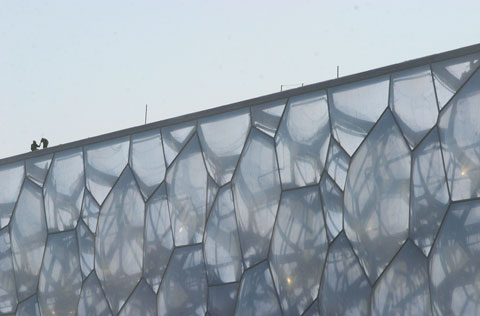
To avoid the same fate, Beijing State-owned Assets Management Co., Ltd and owner of the National Aquatics centre, has signed a tentative contract with China National Sports Group (CNS) to manage the "Water Cube" after the Games are over. "Since construction began, it was necessary for us to plan post-Games operation and keep it sustained after August 2008", said Wang Yuxi, general manager of CNS. The management company is in charge of providing professional advice on the design, function areas, and exploring commercial uses for the stadiums after the Olympic Games. Bi Jinbo, a CNS official refused to divulge further details in the yet to be released report. He stressed that their post-Games management is 'client-oriented' and 'market-oriented'. "We are aiming at building up a comprehensive aquatics amusement centre, including swimming pools, diving areas, paddling park for the public as well as professional fields for national teams and big swimming events." Beijing has planned to remove 11,000 seats installed inside the swimming center out of the total 17,000 seats, for the sake of reducing maintenance costs. The International Amateur Swimming Federation (FINA) regulated that a venue with 4,000 seats or more is capable of hosting an international swimming event. Thus, the 6,000 remaining seats just meet the standard. The design of the swimming center would first ensure the usual standard for training and swim meets, and so those elements take precedence over the public's needs. Bi gave an example, saying that for international swim meets, the dressing room should be a long distance to the swimming pool; but in public pools, people are used to walking a short passage to get to the pool. In addition, exhibition space, hotels and even shops could be added to these Olympic facilities to increase traffic. "I am confident we will run the stadium smoothly in the post-Games period under a modern sports management format," Bi added. |
|