|
|||
 |
|||
|
|||
|
|||
|
|||
|
|
||||||||||||||||||
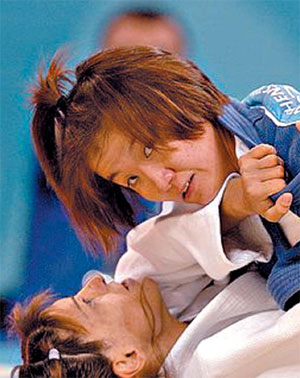
'Girl power' fuels Japan's Olympic comeback(China Daily)Updated: 2007-03-02 11:23 Japan enjoyed a renaissance at Athens 2004, more than tripling its gold medal crop from the Sydney Games to end a five-Olympiad slump that followed the Los Angeles Games in 1984. Eight of the country's 16 gold came in Judo - double its previous record.
Not since Tokyo ploughed $3 billion into hosting the 1964 Summer Games had the country matched such a gold rush. In that year, Japan quadrupled its overall gold count from Rome 1960 to host a successful coming out party, years before Sony became a worldwide brand. One of the highlights in Tokyo was seeing Japan's women's volleyball team - a powerhouse in the 1960s - storm to gold. Again in Athens the women led the charge, with female judoka bagging five gold to help Japan rank fifth overall behind Australia. Japan's other gold came in swimming (3), wrestling (2), athletics (2) and artistic yoga (1). Mizuki Noguchi became Japan's second female marathoner in as many Olympiads to top the podium after clocking 2 hours, 26 minutes and 20 seconds. But even she couldn't beat compatriot Naoko Takahashi's Sydney time of 2:23.14. Given the baseball-obsessed country's "failure" to meet expectations in emerging strongholds like women's softball and soccer (and baseball, narrowly), coupled with a social environment that has witnessed a waning interest in sports for years, Japan's comeback was remarkable. At the forefront of this display of 'girl power' in Athens stood Ryoko Tamura, a 146-centimenter judoka who married Olympic baseball star Yoshitomo Tani in 2003. Ryoko's ultimately-rewarded quest for Olympic gold after debuting as a 16-year-old at Barcelona 1992 is credited with reigniting interest in judo among female Japanese. Nicknamed "Yawara-chan" after the manga comic book character, she lost two successive finals in the extra-lightweight division, even snapping an 84-match winning streak at the Atlanta gold match, before seizing gold in the 48-kg in Sydney with an emphatic 36-second ippon victory. Four years later and with four consecutive world championships under her belt, she became the first Japanese woman to win a second title at the Athens Games. But Athens wasn't a one-woman show. While judo team captain Kosei Inoue failed to clinch a second straight gold in the face of popular expectation, Tadahiro Nomura became the first male judoka to win a third consecutive gold with his victory in the 60-kg division. Japan's men then stole the glory by edging Team America and China for the prestigious men's team gold in artistic gymnastics, a nostalgic reminder of Japan's past success. The men's team last won gymnastics gold at the 1976 Montreal Games, capping a run of five consecutive Olympic victories that had built them up into an unbeatable force on the parallel bars. Athens also spread the glory of Japan's swimmers, especially heartthrob Kosuke Kitajima. He nailed the 200-meter breaststroke in an Olympic record time of 2:09.44 after winning the 100m event. Kosuke told Time magazine: "We're just getting back to where we were before, when we were a strong swimming nation. I think there's a sense that we're matching our past, not surging ahead in any way." |
|